Climate risk reporting, based on the Task Force on Climate-related Financial Disclosures (TCFD) framework, involves assessing and disclosing the financial impacts of climate change on businesses. This framework helps organizations assess their climate-related risks and opportunities, delivering transparent information for informed decision-making. By aligning with TCFD recommendations, companies can enhance resilience, ensure regulatory compliance, and demonstrate their commitment to sustainability.
TCFD disclosure:
Founded by the Financial Stability Board, the Task Force on Climate-related Financial Disclosures (TCFD) highlights the complex connection between environmental risks and financial stability, encouraging organizations to openly address their climate-related vulnerabilities and opportunities.
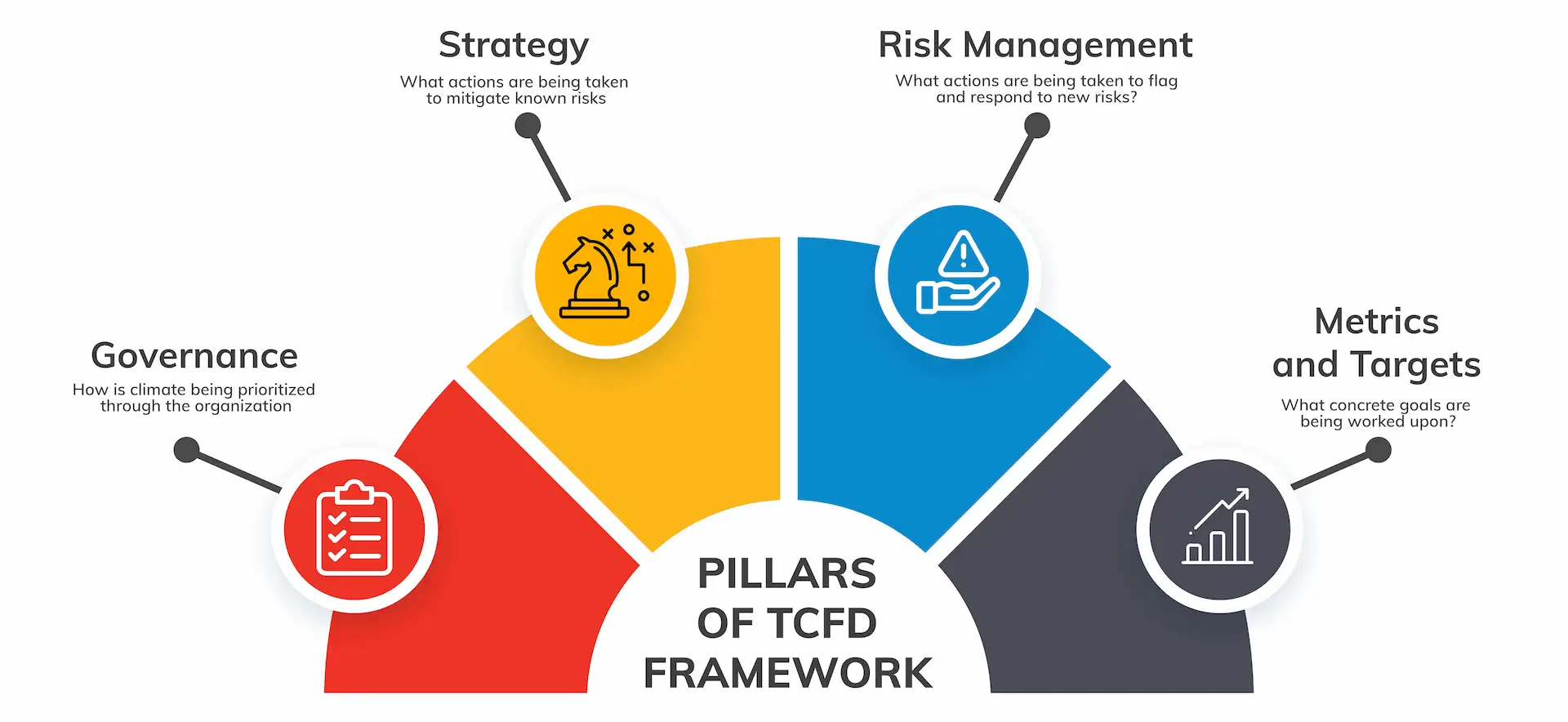
TCFD establishes a comprehensive framework for companies to disclose these risks and opportunities, enabling stakeholders to evaluate financial impacts across four essential pillars: governance, strategy, risk management, and metrics & targets.
Why tackling climate risk is no longer an option?
Addressing climate risk is essential for businesses due to the significant financial and regulatory consequences of inaction.
- Physical Risks: Extreme weather and rising sea levels can disrupt operations and damage assets, necessitating proactive preparation.
- Transition Risks: Companies must adapt to evolving regulations and technologies to avoid stranded assets and maintain competitive advantage.
- Stakeholder Expectations: Investors and consumers increasingly demand transparency on climate risks, making proactive management crucial for trust and market positioning.
- Long-term Viability: Integrating climate risk into strategic planning ensures long-term success and opens opportunities for sustainable innovation.
Our scope of work
- Assess with our excel based tool, the company's exposure to physical and transitional climate risks and their short- and long-term impacts on assets, operations, and financial performance.
- Perform materiality assessment aligned with TCFD requirements.
- Conduct scenario analysis to model the effects of climate-related events
- Use risk mapping techniques to visualize climate-related risks.